

Sometimes, traveling is an ignorance buster, smashing perceptions out of our intellect. I welcome any opportunity to learn about the people who shaped our great nation.
Since we started RVing seven years ago, Santa Fe has become our gateway stop to the American Southwest. It never disappoints. Santa Fe, to me, bursts with creativity and architecture teminding us of the many cultures that form this concoction, which is America.
Enjoy the photo gallery at the bottom of this post.
Santa Fe exudes an aura of blue calm—a place to explore and create. There are many things to do in Santa Fe, with incredible art museums, including the Georgia O’Keefe Museum, shopping, dining, gastronomy, history tours, hiking, and bike trails.
Beastly Books, an indie bookstore owned by author George R.R. Martin is our favorite and has an excellent location in the Railyard District.
My story is about a town close by that was nothing like we imagined.
Each time we visit, we explore someplace new outside of Santa Fe. This time, because of the Oppenheimer film’s popularity, we set our sights on Los Alamos. I’d heard the buildings from the Manhattan Project era were open to the public, along with a small historical museum. Because I was under the impression that once WWII ended, everybody had left town, I imagined a dusty, quiet, isolated small place—those with a feeling that time did not pass. There is nothing further from the truth.
Our adventure began with a scenic drive. We parked our motorhome at Santa Fe Skies, about 46 miles from downtown Los Alamos. We approached Los Alamos on New Mexico’s Highway 502, a broad and scenic road that should have been a clue that we were not on our way to an isolated place.
When I followed directions to the Los Alamos National Laboratory, I thought this must be the place that was the Manhattan Project’s original building. I don’t know what I was thinking. Better; I was not thinking. D’oh! I am ashamed of not researching further and for following my perception so well that I ignored the obvious signs of what we were about to discover. It’s funny how, when we convince ourselves of something, we disregard everything else.
Los Alamos sits between the Rio Grande and the Valles Caldera on the Pajarito Plateau, a volcanic rock created by multiple eruptions from 500,000 to 1.25 million years ago.
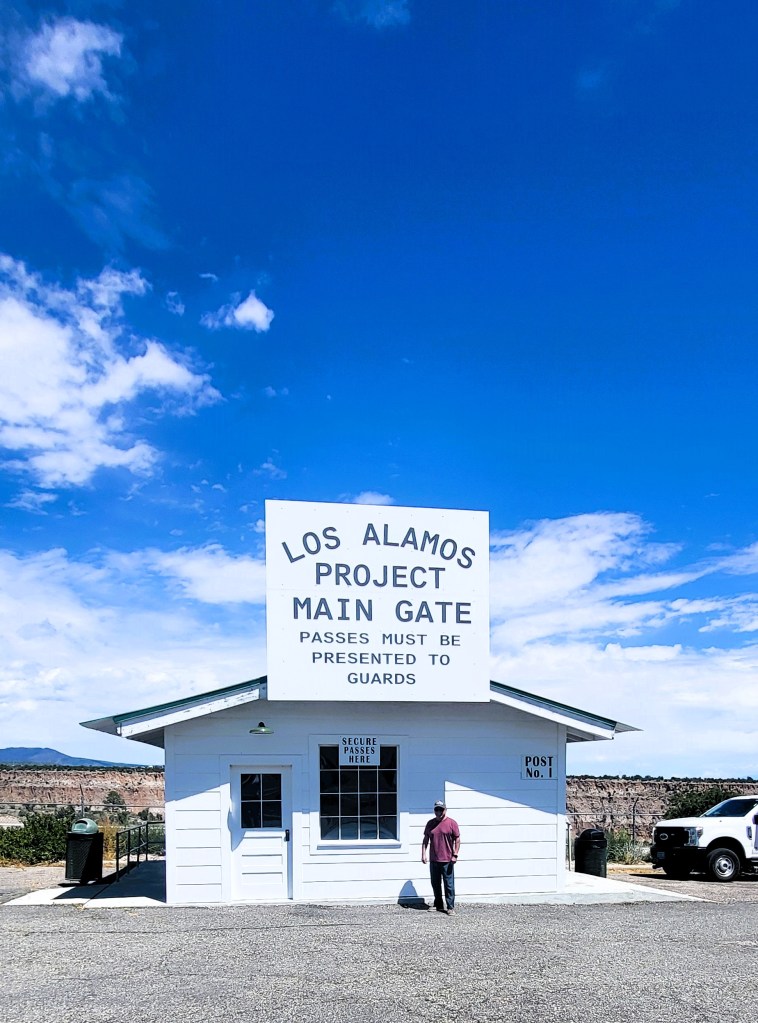
Our first photo stop was at Main Gate Park. The small building is a recreation of the historic security gate all Manhattan Project workers passed through to enter Los Alamos. Its current location is not the original site. The museum staffer told us it was an art school project, like the famous PRADA shop in Marfa, that was so well received in the community that it became permanent.
We continued into town in awe of the modern roads and businesses. Many buildings were from the mid-20th century, which I’m a big fan of. We continued past the Manhattan Project National Historical Park sign because we still followed directions to the LA National Laboratory. Hmm, why isn’t the laboratory there? We wondered. We continued as traffic increased. We could see incredible views of the mountains and valleys nearby between buildings.
Before we knew it, we approached a gate—a real one. The greeter asked for my ID and let us through. Where are we??? We had no grasp on anything. It was wild. We saw many young men strolling around with backpacks and eyes on their phones. They all wore lanyards with photo IDs. In front of us, a modern building with blue glass walls stunned us. I was driving, dealing with traffic, and figuring out where we were.
What happened to the sleepy town we expected? The museum staffer told us the laboratory employs about 18,000 people. It is one of the sixteen research and development laboratories of the United States Department of Energy. It is known for its central role in developing the first atomic bomb. Project Y, a top-secret site for designing nuclear weapons under the Manhattan Project, was revealed to the public after the war ended in 1945. However, the research did not stop after the war; many more developments in bomb design came to Los Alamos during the Cold War.
Today, LANL conducts research in national security, space exploration, nuclear fusion, renewable energy, medicine, nanotechnology, and supercomputing.
Dazed and confused, we drove to the place we should have been looking for: the Manhattan Project National Historical Park. But the detour to the LANL was the highlight of the trip.
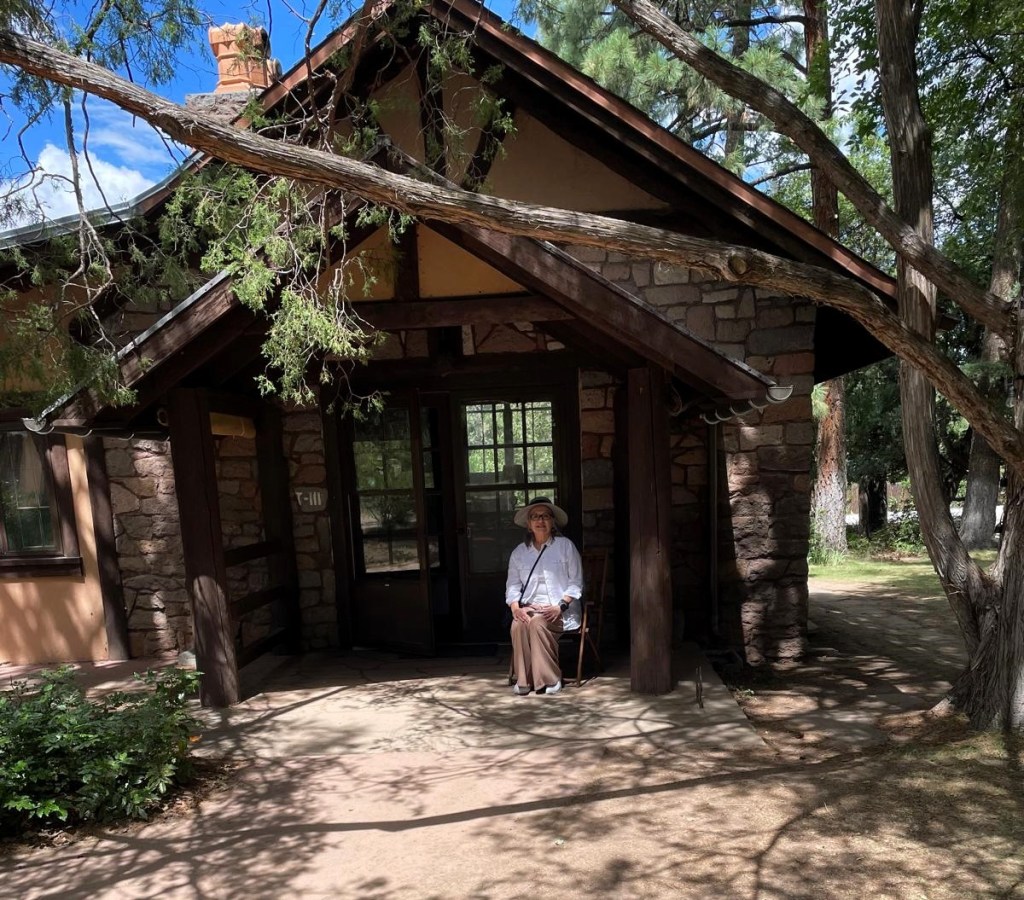
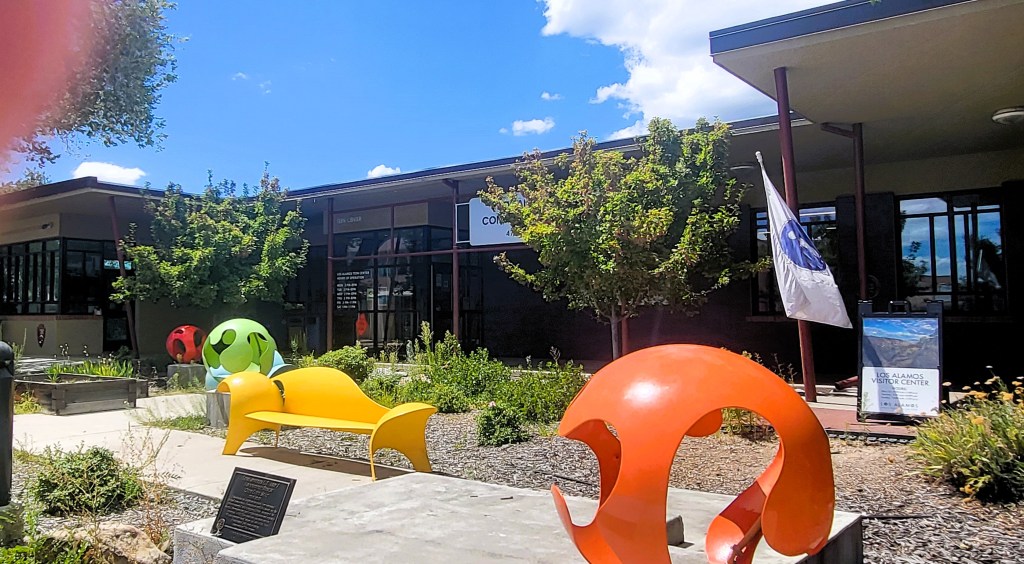
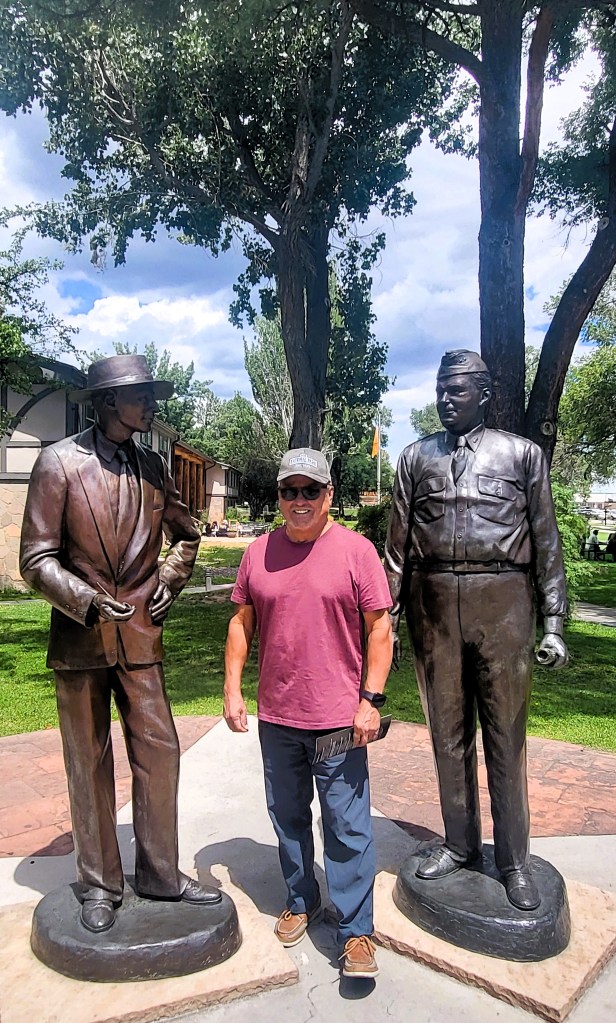
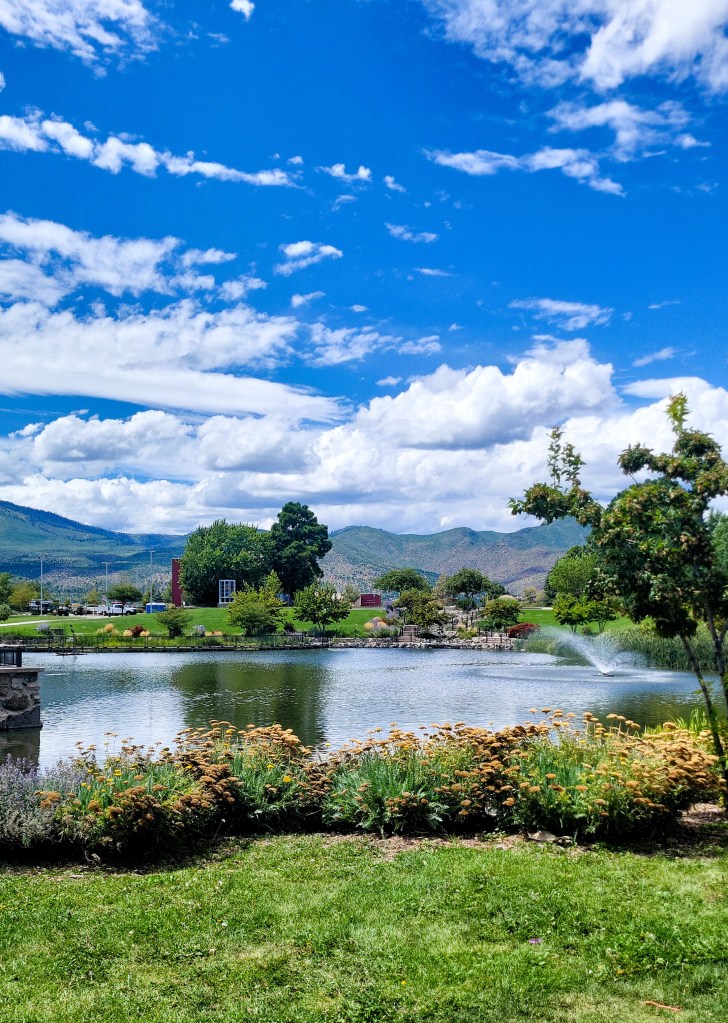
We finally parked by the beautifully landscaped historical park. We loved the blue Ashley Pond and the shaded paved trails in Central Park Square. The historical buildings and the museum are well-maintained and curated.
We noticed the Bathtub Row Brewing Company with a Harvest Hosts sign across the street from Central Park Square. Harvest Hosts are places RVers can park for one night at no cost. It is dry camping where guests spend money supporting hosts and enjoying a good time, not to mention spending a night in such an iconic place.
If you ever visit Santa Fe, I encourage you to take a day trip to Los Alamos. We hope to go back for a weekend. There are plenty of events scheduled throughout the year.
Adjacent to Los Alamos is the impressive Bandelier National Monument, where you can explore original cliff dwellings and hike historic trails. I seldom share links, but there is so much to Los Alamos; you can read about it here. More on the Manhattan Project here.
If you’re interested in archeology and Hispanic Heritage, Los Alamos’s early history dates back to the 1100s, when Ancestral Pueblo people arrived in the area and established villages. The earliest settlers to live there were hunter-gatherers from over 10,000 years ago. Learn more about discovering Los Alamos here.
The recommended airport to visit Santa Fe is Albuquerque. For fellow RVers and Roadtrippers, I recommend visiting the area in the Spring or Fall. We visited in late August, and Santa Fe was hot. Los Alamos was pleasant because of its altitude of over 7,300 feet and dry air.
Thank you for reading my story. If you have any questions about this or any other story, please contact me at contact@nydiao.com. I’d love to hear from you.
Also, if you have questions about RVing, planning a trip, or booking lodgings, I am here to help.








Hispano Communities – “Hispanos descend from Spanish settlers who came to the Southwest centuries ago before it was annexed to the United States in 1848. Those from the Rio Grande Valley maintain connections to the Pajarito Plateau where they homesteaded and farmed from 1887 to 1942.
Hispanos, decedents of early Spanish settlers who first arrived in this region in 1598, homesteaded and farmed on the Pajarito (pa-ha-ree-toe) Plateau from 1887 to 1942. By the late 1930s about 36 families had established homesteads on the plateau, which they used for seasonal farming, ranching, and gathering of resources, such as timber, game animals, and wild edible plants. These summer farms helped sustain farms helped sustain families whose permanent homes were in nearby villages and land grant settlements, such as San Ildefonso, Pojoaque, Jacona, and Española. The Hispano connection to the land of the Pajarito Plateau is rooted in centuries of traditional use. Many families saw homesteading as a means to reclaim lands from Spanish and Mexican land grants that were lost after the annexation of the New Mexico Territory from Mexico in 1848. Homesteading on the Pajarito Plateau came to an end in 1942 when the land was appropriated by the U.S. government for the Manhattan Project. Many of the homesteaders returned to work at Los Alamos during the Manhattan Project. Their descendants, as well as other family members from the surrounding Hispanic communities, continue to work at Las Alamos National Laboratory and play a crucial role in fulfilling the laboratory’s mission. ” excerpt from here.
 Cactus in the Mirror by Nydia O. Studio
Wow! Fantastic, Lupe and Nydia, a very interesting experience and an awesome story! Congratulations 👍🏽🙅🏽♂️
LikeLiked by 1 person
Thank you !
LikeLike
loved sharing this trip with you!
LikeLike